Inspector Lejeune
The Pale HorseDivisional Detective-Inspector Lejeune is the investigator of Father Gorman’s murder, a quiet but perceptive police officer whose inquiry depends on separating observation from assertion. He treats Zachariah Osborne’s detailed account of a man following Father Gorman not as proof in itself, but as a claim to be tested against the fog, distance, and the witness’s opportunity to see. That scrutiny redirects attention from the supposed follower to the person who described him.
Identity and Presence
Lejeune is a sturdy, dark-haired, grey-eyed man whose manner is misleadingly quiet. His gestures can be unexpectedly expressive, a feature associated with his French Huguenot ancestry. The contrast between a reserved manner and vivid movement gives him a distinctive physical presence without making him seem theatrical; his characteristic force emerges instead in the precision of his questions and the patience with which he revisits an account.
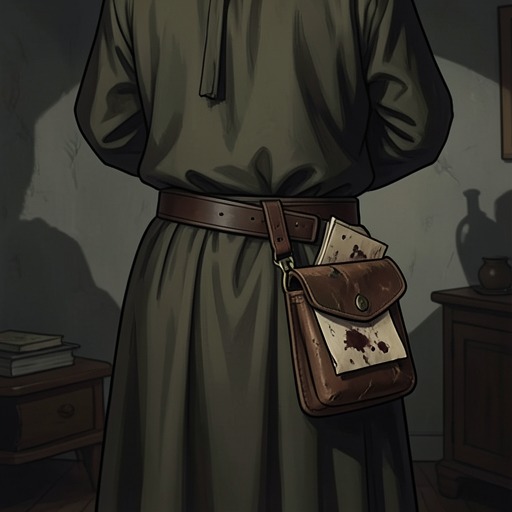
He works closely with Dr Corrigan, who enters his room after examining Father Gorman and reports that the priest had been struck with a cosh. Lejeune asks whether the violence exceeded what robbery would require, considering whether the killer might have wanted something beyond the small change. When Lejeune later shows Dr Corrigan the creased piece of paper found in the investigation, it proves to be only a list of names. The exchange presents him as attentive not just to the manner of the killing but also to what the assailant may have sought.
Building the Inquiry
The first accounts Lejeune receives offer little. The other lodgers in Mrs Davis’s house barely knew her, and the woman who had seen Father Gorman enter Tony’s Place could add no more than the time and direction of his movements. Osborne, the chemist whose shop stood on the corner of Barton Street, appears to offer something much more substantial: a description of the man he says followed the priest.
Osborne estimates that the man was between five feet eleven inches and six feet tall, very thin, with sloping shoulders, a prominent Adam’s apple, long hair beneath a Homburg, and a pronounced nose. He places the man at about fifty, judging partly by his walk, while acknowledging that he could not see his eyes. Lejeune considers whether such specificity reflects an unusually vivid imagination or accurate observation. Unlike the fanciful descriptions witnesses sometimes construct, Osborne’s account sounds to him like a possible description of a real person. He therefore asks whether Osborne would recognize the man again rather than accepting the description at face value.
Testing Osborne’s Identification
Osborne’s confidence remains important to Lejeune, but it does not settle the question. When medical evidence establishes that the man seen by Osborne could not have been Mr Venables, Lejeune returns to the chemist to understand the grounds for his certainty. He has stood in Osborne’s doorway and looked across the street; on a foggy night, he found that a figure at that distance would be difficult to distinguish clearly. His visit is driven by a discrepancy between the conditions he has assessed and Osborne’s emphatic identification.
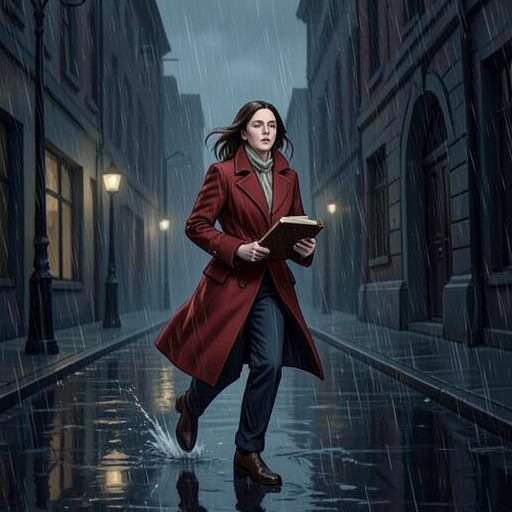
Osborne explains that the fog came and went in patches. In a brief clear interval, he says, he saw Father Gorman and the man following him. As the second man passed the shop, he lit a cigarette, briefly making his profile clear. Osborne says this let him see the nose, chin, and Adam’s apple, and that he remembered the striking-looking stranger because he had never seen him in the shop. Lejeune listens to this account, but the explanation does not erase the original difficulty: he has already judged that the distance and fog make the claimed detail suspect.
From Witness to Suspect
Lejeune later explains that Osborne’s statement itself first drew his attention. The police had asked anyone who saw Father Gorman that night to come forward; Osborne did so, but Lejeune regarded the account as a palpable lie. An aquiline nose might have been visible in profile across the street, he reasons, but the Adam’s apple was too specific for the conditions. He allows that the exaggeration might initially have been an innocent bid for importance. Rather than treating that possibility as an answer, he uses it as a reason to look more closely at Osborne.
What Lejeune learns about Osborne’s past gives the suspect’s self-presentation a wider context. Osborne speaks readily about himself, and Lejeune forms the impression of a man who has long wanted to matter more than his circumstances allowed. He had left his father’s old-fashioned business to try acting, without success; Lejeune suspects he could not accept direction. Osborne had also spoken of wanting to be a witness in a murder trial who successfully identified a person attempting to buy poison. Lejeune thinks that ambition was probably sincere and that such fantasies occupied Osborne’s thoughts, though he cannot determine when the idea of becoming a criminal beyond the reach of justice first arose.
Method and Narrative Role
Lejeune’s investigation turns on a distinction between how certain a witness sounds and how much the witness could have perceived. Osborne’s vivid description initially has the shape of useful evidence, and Lejeune takes it seriously enough to examine its details and return to its source. Yet the same precision that makes it persuasive becomes incriminating when measured against the foggy night and the distance between the shop and the pavement.
His method is neither to dismiss the witness as a braggart at once nor to let confidence substitute for verification. He considers an ordinary explanation for Osborne’s false account, then follows the inconsistency until the witness’s appetite for recognition and his account of his own ambitions become relevant. In this way, Lejeune’s quiet persistence turns an apparent identification into a clue about the person making it, while leaving open the point at which Osborne’s desire for importance became criminal ambition.